
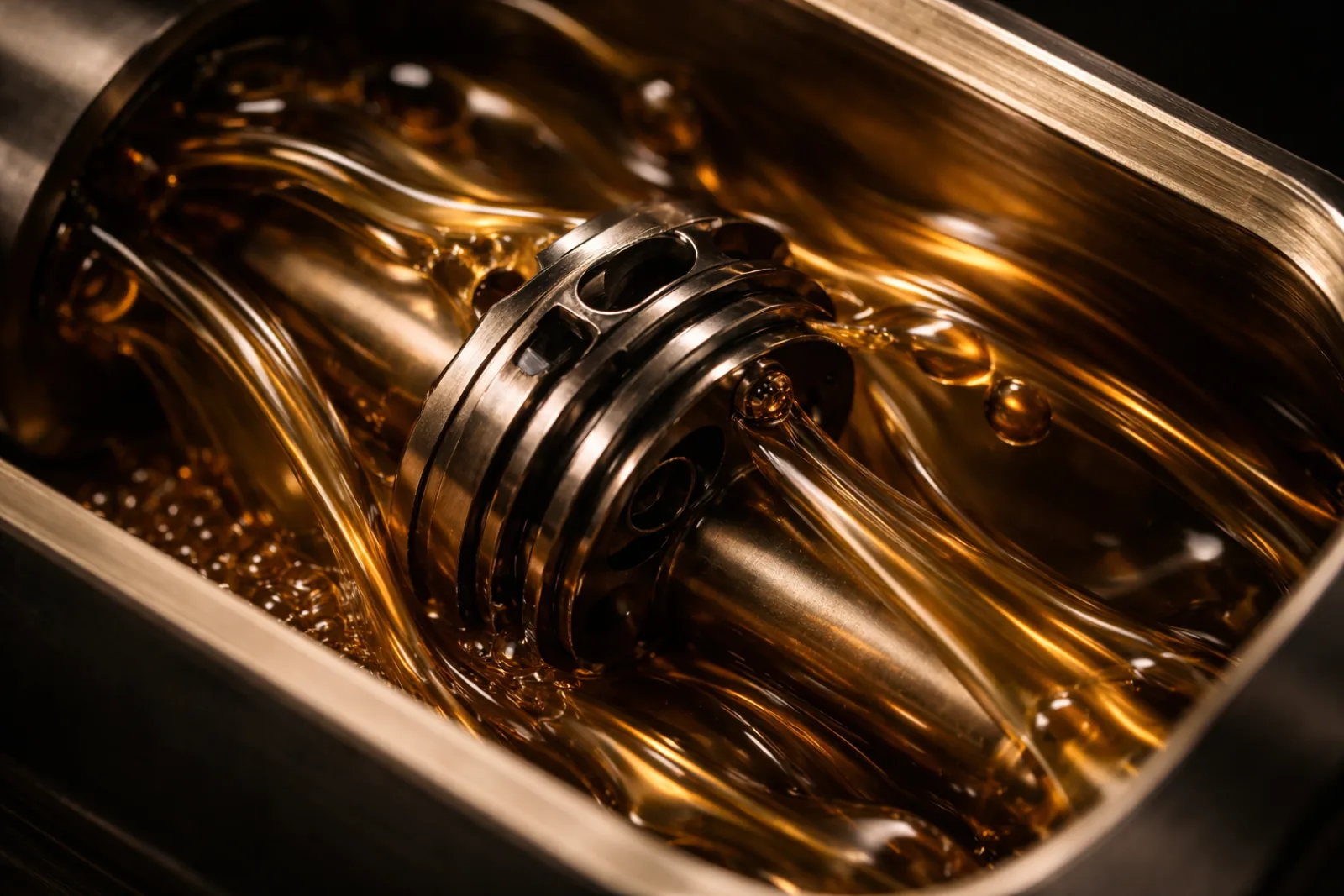
Illustrative rendering. It does not depict the actual Erebus internal design.
When you change every component in a suspension, the interactions change. Erebus valving was redesigned from the ground up so every improvement becomes a coherent system.
In a previous article, we mentioned we would talk about our new seal architecture. We will get there, but for it to make sense, you first need to understand what happens inside a Nimbus unit every time your wheel meets an obstacle.
An oleo-pneumatic system
A Nimbus is an oleo-pneumatic system. Nitrogen acts as a progressive spring, and hydraulic oil flows through calibrated passages to control compression and rebound. During motion, gas and oil mix into a stable emulsion. This is by design, and it is part of what makes our suspensions work the way they do.
The management of those flows is called valving. Think of it as the conductor of the entire system. Valving decides how fast the oil moves, how much resistance it meets, and how the suspension transitions from absorbing a small road vibration to holding firm on a violent impact without harsh bottoming.
A problem we had not anticipated
When we started integrating every new feature into Erebus, we ran into a problem we had not anticipated.
Changing the rod coating to TiN changes the friction coefficient. Changing the bearings to FLURO changes how the suspension articulates. Changing the surface treatment to hard anodization changes thermal behavior. Each improvement, on its own, is a clear step forward. But when you combine them, every interaction changes. The oil does not flow the same way. The emulsion does not behave the same way. Internal pressures evolve differently.
The valving we had on Vibranium worked well. Very well. But keeping it unchanged on Erebus, with everything else having moved around it, would have been like keeping the same recipe after replacing every ingredient. It simply could not produce the same result.
Starting over
So we started over. A complete rethink of our approach to valving, built from the ground up with every new variable accounted for from day one: friction, articulation, thermal behavior, emulsion dynamics, load profile. Every parameter recalculated, every interaction re-measured, every flow re-profiled.
And that is where the material change comes in.
The material that changes everything
The internal components that manage oil and emulsion flow now use a material that is more flexible than what we had before. More flexible means it follows micro-movements more closely, responds faster to small inputs, and provides finer sealing across the entire operating range.
But flexibility alone is not enough. A flexible material that deforms over time loses its properties, and the suspension gradually changes character with every mile. What we found is a material that combines this flexibility with the ability to return to its original shape over the long term. It flexes when it needs to, and it comes back to exactly where it was when the job is done. Year after year.
In practical terms for your suspension: a freshly installed Erebus and an Erebus with 30,000 miles on it will behave nearly identically. The valving stays true to what it was on day one.
The conductor
This is probably not the most spectacular feature in this series. You will not see it. You cannot touch it. But it may be the one that has the most impact on what you feel behind the wheel, because it is what ties everything else together.
TiN reduces friction. FLURO bearings improve articulation. Hard anodization protects the metal. But valving is what transforms those individual gains into a coherent sensation. Without it, you would have good components. With the right valving, you have a system.
That is the difference between an orchestra with excellent musicians and an orchestra with excellent musicians and a great conductor.